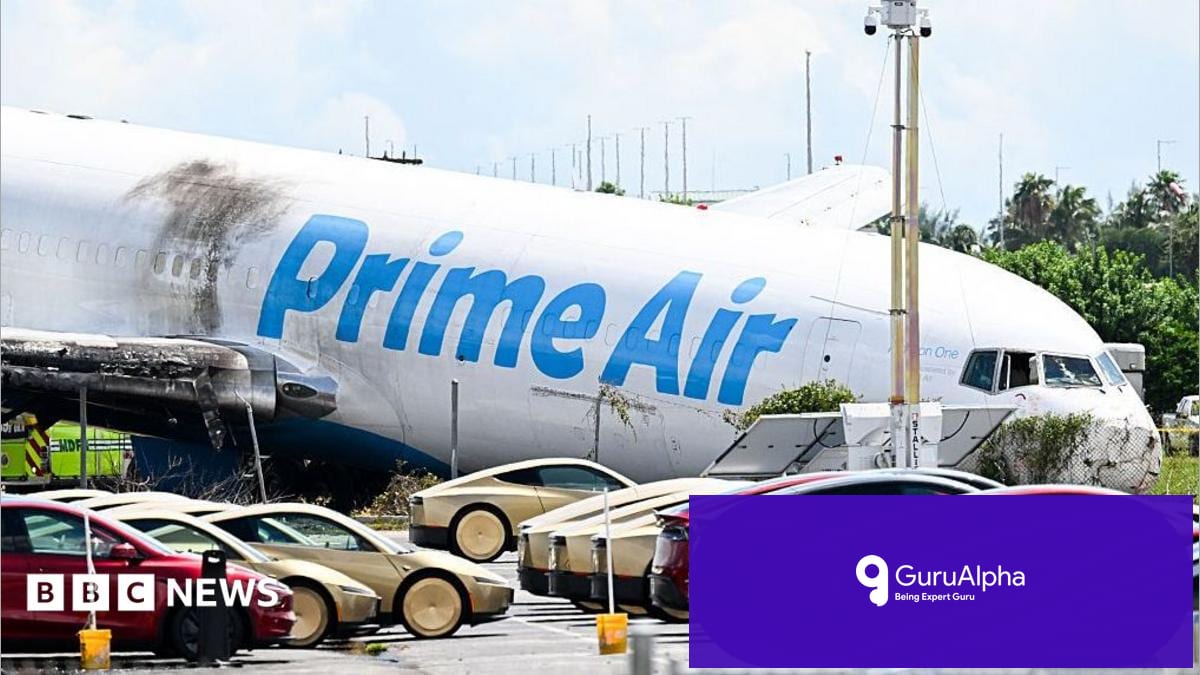
Amazon grounded its cargo flights operated by charter carrier 21 Air following a fatal runway overshoot at Miami International Airport on September 14, 2026. The freighter breached perimeter barriers and struck several civilian vehicles on adjacent roadways, forcing the retail giant to pause operations with the subcontractor while the National Transportation Safety Board (NTSB) and Federal Aviation Administration (FAA) initiate emergency crash investigations.
Runway Excursion in Miami Triggers Immediate Fleet Pause
The incident occurred during an attempted landing on Runway 9 at Miami International Airport, where the 21 Air Boeing freighter failed to achieve sufficient deceleration on a wet surface. After overshooting the paved runway end, the heavy aircraft tore through the airfield perimeter fence, skidded across perimeter access lanes, and slammed into oncoming traffic on an adjacent arterial road. Local emergency responders confirmed multiple fatalities at the impact site, including occupants of crushed motor vehicles.
Federal investigators from the NTSB dispatched a Go-Team to secure the flight data recorder and cockpit voice recorder. Emergency crews closed surrounding roadways for miles around the airport's western perimeter, halting cargo logistics operations across the South Florida transit corridor. Within hours of the crash, Amazon corporate logistics executives ordered an immediate, indefinite operational freeze on all routes assigned to 21 Air.
"Safety remains our absolute non-negotiable standard across every link of our transportation network," stated an Amazon Air spokesperson in an official corporate statement released from Seattle. "We are fully cooperating with the NTSB, FAA, and local emergency authorities as they work to establish the precise cause of this tragic accident. Operations with 21 Air will remain suspended until a comprehensive safety evaluation is finalized."
The High-Pressure Economics of Prime Air Subcontracting
The crash pulls a critical thread in the structure of modern e-commerce logistics: the heavy reliance on Aircraft, Crew, Maintenance, and Insurance (ACMI) wet-lease arrangements. 21 Air, a Greensboro, North Carolina-based supplemental air carrier, operates a dedicated fleet of converted Boeing freighters under contract for major logistics integrators, including Amazon Prime Air and DHL Express. Under these ACMI agreements, the primary brand controls the scheduling and route optimization, while the third-party carrier manages flight crews, aircraft airworthiness, and regulatory compliance.
Over the past decade, Amazon Air expanded its middle-mile delivery network by leaning heavily on ACMI partners to move millions of packages nightly between regional hubs. Subcontracting flight operations allowed the retail giant to scale air cargo capacity rapidly without absorbing the direct capital liabilities of operating an in-house airline certificate. However, this structure places immense operational pressure on secondary carriers to maintain tight turnarounds across high-density flight schedules.
Industry safety data highlights that wet-lease charter providers often operate aging twin-engine freighters—frequently converted passenger aircraft that have accumulated tens of thousands of flight hours. Mechanical reliability, crew fatigue rules, and strict turnaround metrics remain under scrutiny whenever a wet-lease operator experiences a hull loss or major runway incident.
Global Supply Chain Realignments and Fleet Safety Audits
Amazon's decision to suspend 21 Air forces a sudden redistribution of air freight volume across North American logistics corridors. 21 Air previously handled key feeder routes connecting South Florida and Gulf Coast hubs to Amazon's primary air hubs in Cincinnati/Northern Kentucky (CVG) and Fort Worth Alliance (AFW). To prevent operational bottlenecks, Amazon began re-routing priority parcel tonnage to alternative ACMI providers, including Atlas Air, ATSG, and Sun Country Airlines.
The suspension serves as a stress test for middle-mile logistics infrastructure just ahead of peak autumn shopping volumes. Rerouting cargo requires rapid re-allocation of ground handling crews, unit load devices (ULDs), and landing slots across major regional airports. Federal regulators are expected to inspect 21 Air's maintenance records, training logs, and operational compliance to determine whether systemic issues contributed to the Miami overshoot.
Logistics analysts expect the NTSB preliminary report within 30 days, which will detail wind shear data, brake system performance, tire wear metrics, and airport Engineered Material Arresting System (EMAS) functionality at Miami International Airport. Until investigators clarify whether the accident stemmed from mechanical failure, pilot error, or environmental conditions, 21 Air's fleet remains grounded from Amazon's global air network.
Frequently Asked Questions
Why did Amazon pause its contract with 21 Air?
Amazon suspended flight operations with 21 Air after one of its cargo jets overshot a wet runway at Miami International Airport, crashing into local traffic and causing casualties. The pause remains in effect while federal authorities complete safety investigations.
Which federal agencies are investigating the Miami runway overshoot?
The National Transportation Safety Board (NTSB) and the Federal Aviation Administration (FAA) are leading the crash investigation. They are analyzing black box flight recorders, runway conditions, and mechanical maintenance logs.
How is Amazon maintaining air cargo deliveries after grounding 21 Air?
Amazon is re-routing parcel tonnage across alternative ACMI subcontracted carriers such as Atlas Air, ATSG, and Sun Country Airlines to ensure network continuity while 21 Air operations are evaluated.